


The Up-Skill project offered participating firms a unique opportunity to explore how emerging technologies can be implemented in real industrial settings whilst maintaining a strong focus on people, skills, and organisational culture.
Across diverse contexts, companies tested, adopted, and in some cases abandoned new technologies, which has generated valuable insights into what it takes to translate Industry 5.0 principles from concept into practice.
Rather than treating technology adoption as a purely technical exercise, the project revealed it to be a deeply organisational and human process—one shaped by leadership, workforce engagement, training strategies, and the ability to learn from both success and failure.
Technologies Implemented Across Firms
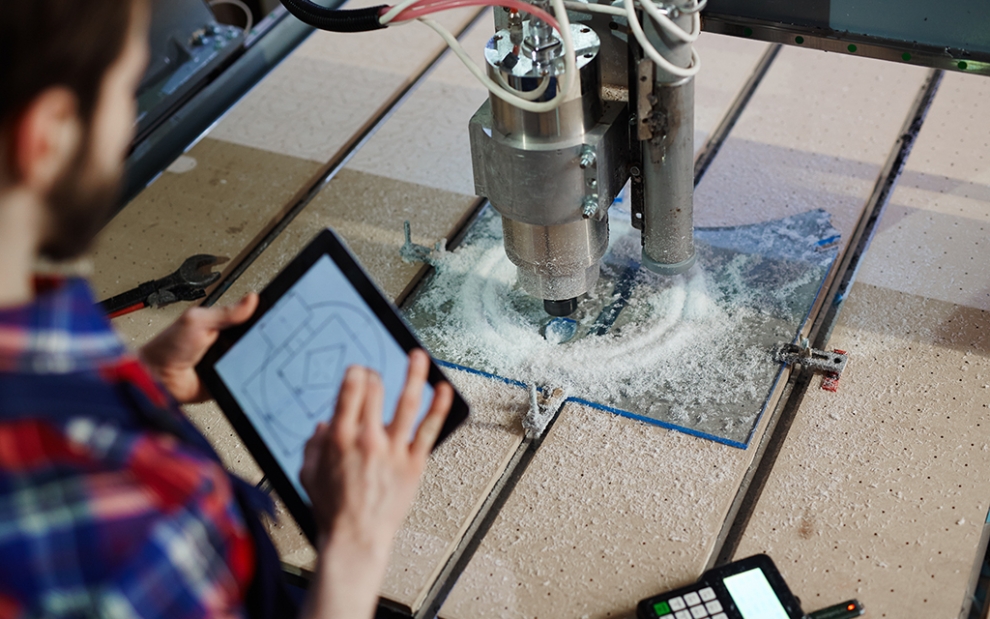
During the project, firms introduced a wide range of technologies aimed at improving production efficiency, flexibility, and knowledge capture. These included Manufacturing Execution Systems (MES), digital status boards, CNC machines, laser welding technologies, water jet cutters, hand scanners for part digitisation, real-time information screens, and 3D printing capabilities for in-house tooling and fixtures.
In several cases, firms integrated MES platforms to improve visibility over production orders and operational performance. Digital boards and monitoring systems were used to support day-to-day coordination and decision-making, helping to make production data more accessible across teams. CNC machines and laser welding technologies enabled higher precision manufacturing, with laser welding proving particularly valuable for complex and safety-critical components such as hydrogen burners.
3D printing was widely explored as a means of increasing flexibility. While large-scale industrial 3D printing was often deemed too costly, smaller in-house printers delivered clear benefits by enabling rapid prototyping and the production of custom fixtures that improved assembly efficiency.
Not all technologies tested proved viable. Mixed Reality tools, for example, were trialled as a means of supporting mentoring and knowledge transfer but were ultimately abandoned due to high maintenance demands, limited repetition in tasks, and the need for specialist programming expertise. Similarly, water jet cutting, while precise, introduced challenges related to downtime, consumable costs, and waste handling. These experiences underscored the importance of evaluating technologies not only for their technical potential, but for their fit with everyday operational realities.
Workforce Engagement, Training, and Cultural Change
A consistent finding across firms was the decisive role of workforce engagement and training. Technology implementation succeeded where employees were actively involved, supported through tailored training, and given space to experiment and adapt. Firms developed blended training approaches combining e-learning, classroom sessions, and hands-on practice in test environments. In some cases, training acted as a catalyst for wider reflection, prompting employees to identify process improvements and rethink established ways of working.
At the same time, resistance to change emerged as a recurring challenge. Scepticism about the value of new systems, concerns over increased monitoring, and fears about job security required careful management. Firms that addressed these issues through open communication, visible managerial support, and the recruitment of internal “ambassadors” were better able to build trust and sustain momentum.
Beyond skills, many organisations experienced a deeper cultural shift. The introduction of new technologies encouraged collaboration across departments, reduced reliance on individual experts, and supported a move towards more programme-based and transparent ways of working. Unexpected benefits also emerged, including stronger team cohesion, the development of frontline leadership, and faster alignment at management and board level around technology investment decisions.
Leadership, Strategy, and Organisational Readiness
The case studies demonstrate that leadership and strategic clarity are critical to successful Industry 5.0 implementation. Firms that approached technology adoption with a long-term perspective, organisational stability, and a willingness to invest in both people and systems were more likely to achieve lasting benefits. Conversely, where leadership was unstable, financial constraints dominated decision-making, or ambitions exceeded organisational capacity, implementation efforts often stalled.
Several firms reflected that initial project scopes were overly ambitious, making it difficult to deliver results within existing structures. Data quality issues and unclear processes for using newly collected data also limited the value of some systems. These challenges reinforced the importance of incremental implementation, clear prioritisation, and continuous learning.
Broader Implications and Lessons Learned
Beyond firm-level outcomes, the experiences documented in the Up-Skill project highlight the broader promise—and complexity—of Industry 5.0. Human-centric and resilient production models that can support sustainability, reduce waste, improve health and safety, and enhance job quality. However, these benefits are not automatic. They require sustained investment, organisational commitment, and a cultural shift that values human expertise alongside technological advancement.
Across the cases, a clear message emerges, successful Industry 5.0 implementation is not about adopting the most advanced technologies available, but about making thoughtful choices that align technology, skills, and organisational goals. Learning from failed trials, investing in people, and fostering collaboration proved just as important as technical capability.